


To find your bra size, you need two measurements: your underbust measurement and the measurement around the fullest part of your bust. You can use these figures to identify the size you should try first. Trying the bra on is just as important as taking accurate measurements. Treat the size shown in the chart as a starting point, not a guarantee that every bra with the same size label will fit in exactly the same way.
The style also matters. Two EU 75C bras can differ in cup depth, wire width and band elasticity. Once you have measured yourself, you therefore need to check that the bra stays in place, contains all your breast tissue and does not press where it should not.
How do you find the right bra size?
- Measure your underbust.
- Measure around the fullest part of your bust.
- Compare both measurements with the size chart.
- Treat the result as your starting size.
- After putting the bra on, check the band, cups, wires, centre gore and straps.
How to measure your bra size
Use a soft tape measure and stand in front of a mirror. You can take the measurements without a bra or while wearing a soft, non-padded bra that does not noticeably change the shape of your breasts. You will need two measurements in centimetres.
How to measure your underbust
Place the tape directly beneath your breasts. It should sit close to your body and remain level across your back. Do not leave extra room beneath the tape, but do not pull it so tightly that it digs into your skin.
Check the measurement while breathing normally and write it down in centimetres. Do not assume that the number on the tape must be identical to the band size on the label. Bra sizes are graded, and the elasticity of the band varies between styles.
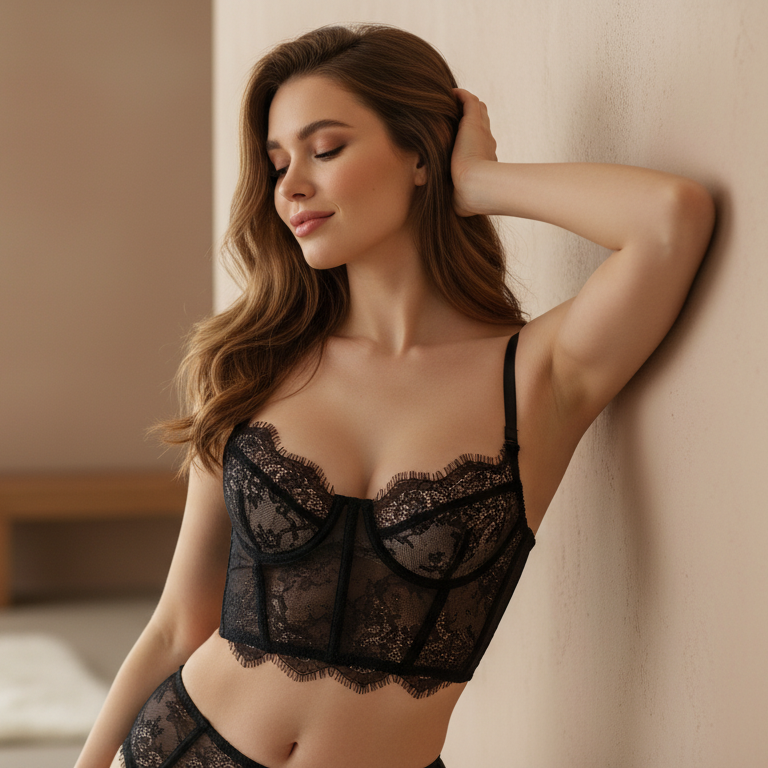
How to measure your bust
Take the second measurement around the fullest part of your breasts, usually across the nipples. The tape should touch your body but must not compress or flatten your bust.
Look in the mirror and check the tape from the side. If it drops or rises across your back, reposition it and measure again. A difference of just a few centimetres can affect the cup size.
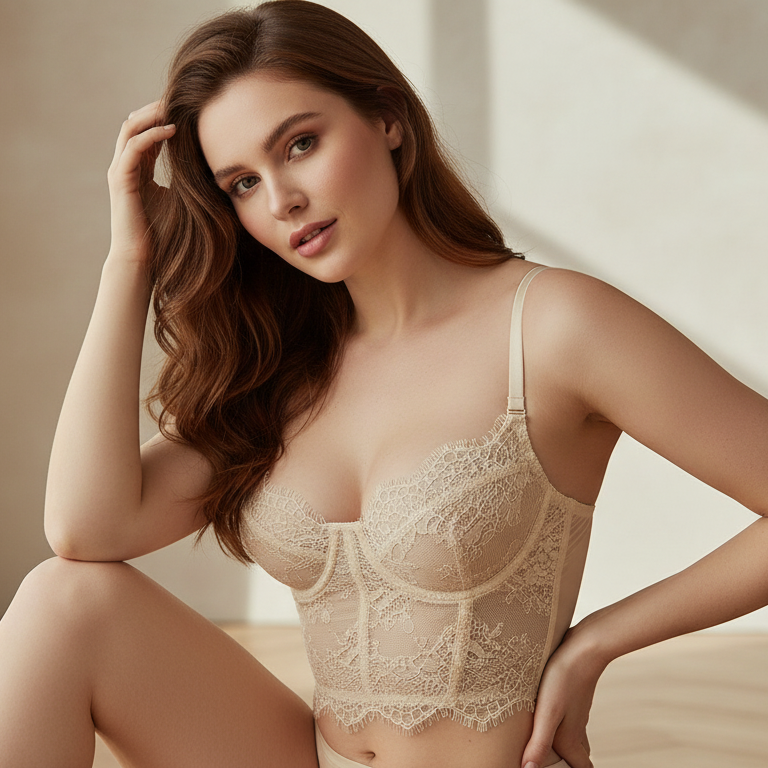
How to work out your bra size
The first part of an EU bra size, such as 70, 75 or 80, indicates the band size. The letter indicates the cup. However, cup size cannot be considered separately from band size. A C cup on an EU 70 band has a different volume from a C cup on an EU 85 band.
The relationship between your underbust and bust measurements is used to identify a cup size. The calculation can vary between sizing systems and manufacturers, so the safest approach is to compare your measurements with the chart provided by the brand whose bra you want to buy.
EU and UK bra sizes
Pelie.co.uk lists bra sizes in the EU system. In the UK system, band sizes are normally shown in inches: EU 65 corresponds to UK 30, EU 70 to UK 32, EU 75 to UK 34, EU 80 to UK 36, EU 85 to UK 38, EU 90 to UK 40 and EU 95 to UK 42. Cup letters A–D are generally the same in both systems. After D, the sequences differ: EU E usually corresponds to UK DD, while EU F corresponds to UK E. When ordering from Pelie, use the EU size displayed on the product page.
Bra size chart
The table below will help you identify an approximate starting size. First find your underbust measurement, then check your bust measurement. If the manufacturer provides a separate chart for a particular bra, use that chart when ordering. For products available from Pelie, compare your measurements with the Pelie size guide.
| EU band size | Underbust measurement | EU cup A | EU cup B | EU cup C | EU cup D | EU cup E | EU cup F |
|---|---|---|---|---|---|---|---|
| 65 | 63–67 cm | 77–79 cm | 79–81 cm | 81–83 cm | 83–85 cm | 85–87 cm | 87–89 cm |
| 70 | 68–72 cm | 82–84 cm | 84–86 cm | 86–88 cm | 88–90 cm | 90–92 cm | 92–94 cm |
| 75 | 73–77 cm | 87–89 cm | 89–91 cm | 91–93 cm | 93–95 cm | 95–97 cm | 97–99 cm |
| 80 | 78–82 cm | 92–94 cm | 94–96 cm | 96–98 cm | 98–100 cm | 100–102 cm | 102–104 cm |
| 85 | 83–87 cm | 97–99 cm | 99–101 cm | 101–103 cm | 103–105 cm | 105–107 cm | 107–109 cm |
| 90 | 88–92 cm | 102–104 cm | 104–106 cm | 106–108 cm | 108–110 cm | 110–112 cm | 112–114 cm |
| 95 | 93–97 cm | 107–109 cm | 109–111 cm | 111–113 cm | 113–115 cm | 115–117 cm | 117–119 cm |
Example: if your underbust measures 74 cm and your bust measures approximately 92 cm, the table suggests a starting size of EU 75C, equivalent to UK 34C. This is the size you can try first. If the band proves too loose or the cup does not fit correctly, you will need to adjust the size.
A size chart is not a substitute for trying a bra on.
Manufacturers’ charts can vary, as can the construction of individual styles. If your measurements fall between two sizes, try both rather than choosing one based only on the measurements.
How to check whether a bra fits properly
Once you have put the bra on, do not judge the fit only by the appearance of your cleavage. A well-fitting bra should stay in place when you move, contain all your breast tissue and not cause painful pressure. Check the band, cups, wires, centre gore and straps in turn.
The band should sit securely
The back of the bra should sit at approximately the same height as the front. Raise your arms and move around. If the band rides high towards your shoulder blades, it is usually too loose. A secure band is one of the main elements responsible for supporting the bust.
A new bra should ideally be worn on its loosest hook. As the material stretches over time, you can move to the tighter hooks.
Your breasts should fit inside the cups
After putting the bra on, arrange your breasts inside the cups, bringing in any tissue from beneath your arms. The top edge should not cut into your breasts, and breast tissue should not spill out at the sides. These signs usually indicate that the cup is too small or too shallow.
However, a gaping cup does not always mean that you need a smaller size. The cup shape may also be responsible. Breasts with less fullness at the top may not fill a tall cup even when the cup volume is correct.
The wires should not sit on breast tissue
In an underwired bra, the wire should surround the breast and sit against the body rather than ending on breast tissue. If the wire presses into your breast near the underarm, try a larger or wider cup.
This rule does not apply to bras without wires. Non-wired bras should be assessed primarily by the stability of the band, the position of the cups and their comfort during movement.
The centre gore should sit close to the body
The central section connecting the cups of a classic underwired bra should sit against the breastbone or remain close to it. If it stands noticeably away from the body, check whether the cups are too small or too shallow.
Soft bralettes and non-wired styles have a different construction, so this rule should not be applied to every type of bra.
The straps should not provide all the support
Adjust the straps so that they remain on your shoulders without digging firmly into your skin. If you need to shorten them considerably to lift your bust, check the bra band. The straps should stabilise the cups, not compensate for an incorrectly fitted band.
Ill-fitting bras: what do the most common problems mean?
Not every fit problem can be solved by choosing a larger or smaller bra. Sometimes only the band or cup needs to change, while in other cases the style itself is the problem.
The bra cups gape
First arrange your breasts correctly inside the cups and adjust the straps. If the fabric still gapes, the cup may be too large or the wrong shape. Do not automatically size down without trying a different style.
The bra rides up
If the back moves up towards your shoulder blades, the band is usually too loose. The bra then loses stability, and the straps begin to do more of the supporting work.
The bra straps slip off
Start by shortening the straps. If they still slip off your shoulders after adjustment, they may be set too far apart or the particular bra style may not suit you. Slipping straps do not always indicate the wrong bra size.
The bra feels tight beneath the bust
Painful pressure may indicate that the band is too tight, but check the cups before changing size. Cups that are too small can push the bra away from the body and make the entire bra feel tighter.
The wires dig in beneath the arms
Check where each wire ends. If it sits on breast tissue, the cup may be too small or too narrow. If it extends far beyond the breast and irritates your underarm, the bra may be too wide or too high at the sides.
Your breasts spill out at the top or sides
This is one of the clearest signs that there is not enough room in the cups. Once you have arranged your breasts correctly, all breast tissue should sit inside the cups without a pronounced line at the neckline or beneath the arms.
What are sister bra sizes?
Sister sizes have a similar cup volume with a different band size. They are useful when the cup fits but the band is too tight or too loose.
For example, if EU 75C (UK 34C) has the right cup volume but the band is too loose, you can try EU 70D (UK 32D). If EU 75C is too tight beneath the bust, its sister size with a larger band is EU 80B (UK 36B).
| Starting size | Tighter band | Looser band |
|---|---|---|
| EU 70C / UK 32C | EU 65D / UK 30D | EU 75B / UK 34B |
| EU 75C / UK 34C | EU 70D / UK 32D | EU 80B / UK 36B |
| EU 80D / UK 36D | EU 75E / UK 34DD | EU 85C / UK 38C |
| EU 85E / UK 38DD | EU 80F / UK 36E | EU 90D / UK 40D |
A sister size may not fit in exactly the same way as your original size. The band and the proportions of the whole bra change, so you still need to try the sister size on.
How to choose a bra for a fuller or smaller bust
The measuring method is the same regardless of breast size. There is also no separate size chart for smaller and fuller busts. However, the fit issues that become apparent when trying a bra on may differ.
Bra sizes for a fuller bust
For a fuller bust, a secure band is particularly important. If it is too loose, the straps may place more pressure on your shoulders. Also check that the cups contain your breasts from below and at the sides and that the wires do not sit on breast tissue.
You will find different constructions among plus size bras, so a wide cup or thicker straps alone do not guarantee a good fit. What matters is how the complete bra fits your individual shape.
Bra sizes for a smaller bust
A smaller bust does not automatically mean an A cup. The cup letter is always linked to the band size. Someone with a smaller bust may therefore wear a C or D cup with a smaller band, and there is nothing contradictory about that.
If the top of the cup gapes, try not only a smaller size but also a different style. A shallower or lower-cut cup may fit better than a fuller-coverage design.
When should you measure your bra size again?
There is no reason to assume that a size measured once will remain suitable for many years. Your underbust measurement and breast shape can change, so it is worth measuring again whenever your current bra stops fitting properly.
Bra size after a change in weight
A change in body weight can affect both your underbust measurement and breast volume. There is no single number of kilograms that will always result in a different bra size. If your bra begins to gape, feel tight or move up your back, take both measurements again. Breast size and shape can change with both weight gain and weight loss.
Bra size after pregnancy and while breastfeeding
During pregnancy, breasts can increase in size and change shape, with further changes occurring after birth and during breastfeeding. The size worn before pregnancy is therefore not a reliable reference point throughout this period.
You should not automatically return to your previous size after giving birth. The NHS notes that both band and cup size can change following pregnancy, so it is sensible to measure yourself again before buying a new bra.
The most common bra-measuring mistakes
Measuring too loosely beneath the bust
If you leave a lot of room between your body and the tape, you may choose a band that is too large.
Holding the tape at an angle
Use a mirror to check that it remains level across your back. A measurement taken at an angle will not be reliable.
Compressing your breasts while measuring
When measuring your bust, the tape should touch your body without flattening your breasts.
Choosing a cup size by eye
You cannot identify a cup letter solely by deciding whether your bust appears small or large. The cup size is linked to the band.
Sticking to one size regardless of style
If your measurements appear correct but the bra still gapes, feels tight or moves when you do, try a different size or construction.
Does the same size fit in every bra?
Not always. Two styles with the same size label can differ in cup width and depth, strap placement or band elasticity. Finding the right bra therefore involves more than identifying a single combination of a number and a letter.
When choosing women’s bras, pay attention to their construction as well. A soft non-wired style will fit differently from a padded bra, a balconette or a bra designed to provide firmer support.
Seamless bras can be useful beneath thin, close-fitting fabrics, but a smooth construction does not change the principles of sizing. You still need to check the band and the position of the cups.
Strapless bras and bandeau styles also behave differently. Their construction must support the bust without standard shoulder straps, so a secure band fit is particularly important. Our guide to which strapless bra to choose for a dress discusses this type of bra in more detail.
If you already know your size but are unsure which style to wear beneath a particular dress, top or neckline, choosing a bra for your clothes is a separate consideration.
How to find the right bra size without making a mistake
Start with two measurements, but do not stop at the size chart. A bra size is right only when trying the bra on confirms it. The band should remain in place, your breasts should fit inside the cups, and the wires in underwired styles should surround the breasts rather than sitting on them.
If one of these elements is not right, do not change everything at once. Work out whether the problem concerns the band, the cups or the construction. Sister sizes may help when the cup fits but the band does not. If the size is theoretically correct but the cup gapes or the wire sits incorrectly, try a different style.
At Pelie, you will find women’s bras in a range of constructions and sizes. When choosing a particular style, compare your measurements with its chart and check the fit after putting it on.
FAQ
How do you measure your bra size at home?
Measure directly beneath your bust and around the fullest part of your breasts. Compare both figures with the manufacturer’s size chart and treat the result as a starting point. After putting the bra on, check the band, cups, wires and straps.
How can you tell if a bra is too small?
If breast tissue spills out at the top or sides of the cups, or the wires sit on breast tissue, the cups may be too small. Firm pressure beneath the bust may indicate that the band is too tight, but first check whether cups that are too small are causing the problem.
What should you do if your bra cups gape?
First arrange your breasts correctly inside the cups and adjust the straps. If the fabric still gapes, try a smaller cup and a different style. Gaping can result from either the size or a cup shape that does not suit your breasts.
What does it mean when a bra rides up?
If the back of the bra moves up towards your shoulder blades, the band is usually too loose. If the cups fit, try a smaller band and the corresponding sister size.
What are sister bra sizes?
These are sizes with a similar cup volume but a different band size. The sister sizes for EU 75C, equivalent to UK 34C, include EU 70D (UK 32D) and EU 80B (UK 36B).
Is bra sizing the same for every brand?
Not necessarily. Manufacturers’ charts and bra constructions can vary. Check the chart provided by the specific brand before buying, and make the final assessment by trying the bra on.
Can your bra size change after pregnancy or a change in weight?
Yes. Changes in weight, pregnancy and breastfeeding can affect your underbust measurement as well as the size and shape of your breasts. If your current bra has stopped fitting properly, measure yourself again.
References
- Frimley Health NHS Foundation Trust, Bra Measurement.
- Wacoal, 5 Points of Fit and guidance on correct bra fitting.
- Bravissimo, Bra Sister Sizes – Sister Size Charts.
- NHS, Keeping Fit and Healthy with a Baby.
- Wirral University Teaching Hospital NHS Foundation Trust, Breast Changes in Pregnancy and Breastfeeding.
- Mersey and West Lancashire Teaching Hospitals NHS Trust, Possible Breast Changes.


